Thursday, April 11, 2013

end of March to mid April

Vocabulary Quiz - April 15
Please check your science journal for a list of 20 words over Physics (should be around page 144)


Lately we have been studying Physics (the study of forces and motion).
You should know how to apply the definitions of force to motion of objects. The rate of motion is measured as speed. We have different labs including toys to measure the distance and time an object takes and using this to calculate speed.


You will need to be able to graph speed as well.

Thursday, March 21, 2013

Spring Break to end of March

Energy Test Review - Benchmark March 28
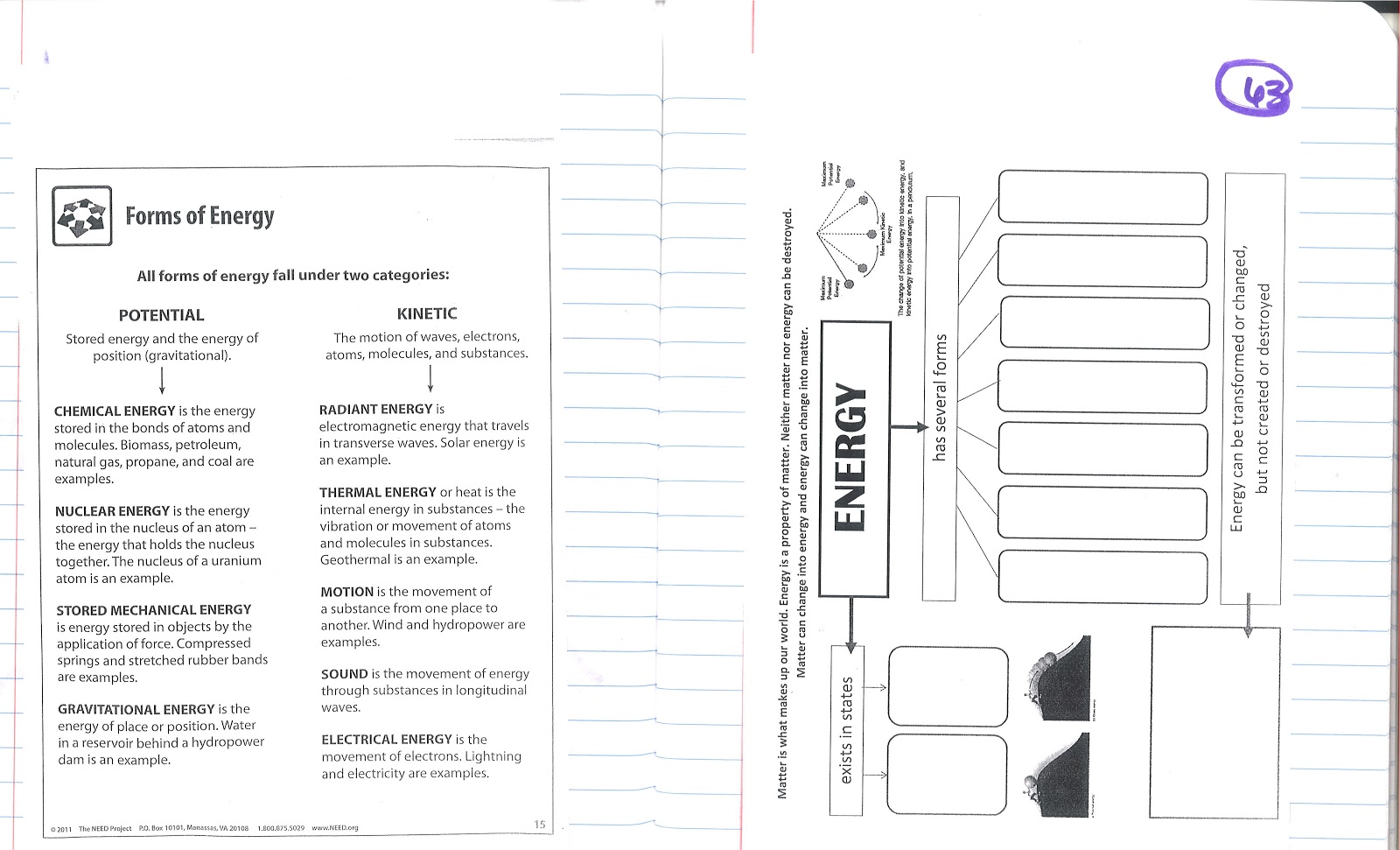
Energy is the ability to do work. Energy can be divided into two main states: kinetic (energy in motion) and potential (energy that is waiting or stored). These two states of energy can be divided into several forms of energy: Mechanical, Radiant, Sound, Chemical, Heat/Thermal, Electrical and Nuclear (MRS CHEN).
Energy can’t be destroyed or created, simply transformed from one form to another. We harness this transforming ability to power our homes with electricity. We can use different energy resources to generate electricity (generally by creating steam, which turns the turbine, which turns the generator). Energy resources may be renewable or nonrenewable.
Think about and be able to answer the following AT MINIMUM:
1.       Where does a roller-coaster have the most potential energy (remember this is the same as the least kinetic)?  Kinetic energy is based on mass [more mass = more KE]
2.       List advantages and disadvantages of hydroelectric dams, geothermal, windmills, solar, nuclear, fossil fuels
3.       Be able to describe energy transformations in: a) hand-held devices such as radios or flashlight or b) electrical devices like video games c) photosynthesis and d) glow sticks 
EX: Flashlight – chem (battery) à electrical (wires) à light   
4.       Be able to give examples and define all 3 forms of heat transfer:
Heat travels in all directions but moves from warm to cool
a.       Convection
b.      Conduction
c.       Radiation
5.       Be able to describe key parts of an energy plan for home and school like the 3 Rs: reduce, reuse, recycle OR turn off lights and appliances at home to save energy use
6.       Give examples of different energy resources:
a.       geothermal energy: Geyser                        b. nuclear energy: power plant or the sun

Tuesday, March 5, 2013

March 4- spring break

We are still in our energy unit,but we are incorporating ideas that energy transformations happen all around us every day.
We demonstrated that with several labs and a lab practical using some of these items. Your student should be able to explain the transfer for each item shown below.


We are also adding knowledge of different energy-producing resources that may be used to produce electricity.

Electricity is, simply, produced when a fuel source turns a turbine and generator, moving electricity (electrons) to a battery or outlet for use. Different fuel sources (resources) may be used to produce the mechanical energy necessary to turn the turbine.

We are researching and debating the advantages and disadvantages of different resources, including:
fossil fuels
nuclear power
biomass
hydropower
solar
wind
geothermal

Sunday, February 24, 2013

Feb 25 - March 1

This week we are planning to incorporate all forms of energy into our study, not just Heat or Thermal Energy. Each form of energy will fit under either POTENTIAL or KINETIC energy forms.

We will use the phrase MRS CHEN to remember all the forms

M - mechanical (KE)
R - radiant (KE)
S - sound (KE)
C - chemical (PE)
H - heat (KE)
E - electrical (KE)
N - nuclear (PE)

This study is leading to the understanding that each form of energy transforms into other forms of energy very easily.

For example:
A blow dryer converts electrical energy into heat and sound energy.
A turbine converts heat into mechanical energy which in turn becomes electrical energy.

Our week was filled with mini labs using toys to demonstrate the energy changes when using toys and everyday objects.

February 10-22

In this time, we finished studying about kinetic and potential energy.

We also began and ended a focus on the energy form thermal or heat energy (a subsection of kinetic energy). We discussed the 3 ways that heat can travel: conduction, convection and radiation.

We had a lab using a curly cue to demonstrate convection and a lab melting chocolate chips to mainly demonstrate conduction, but we tied in all 3 ways to transfer heat.

Friday, February 8, 2013

February 4 - 8

This week we started studying Physics. This will be a long unit covering the states and forms of energy and how energy relates to matter in motion (speed).

This week we started with the two major groups of energy--kinetic and potential energy---and the Law of Conservation of Energy.

We demonstrated the greatest amount of potential energy differs by object, but it is based on the position and mass of an object. Kinetic energy is the energy of matter in motion.

Vocabulary and cover page
to be completed as we go through different forms of energy

notes on KE and PE