We are still in our energy unit,but we are incorporating ideas that energy transformations happen all around us every day.
We demonstrated that with several labs and a lab practical using some of these items. Your student should be able to explain the transfer for each item shown below.
We are also adding knowledge of different energy-producing resources that may be used to produce electricity.
Electricity is, simply, produced when a fuel source turns a turbine and generator, moving electricity (electrons) to a battery or outlet for use. Different fuel sources (resources) may be used to produce the mechanical energy necessary to turn the turbine.
We are researching and debating the advantages and disadvantages of different resources, including:
fossil fuels
nuclear power
biomass
hydropower
solar
wind
geothermal
Tuesday, March 5, 2013
Sunday, February 24, 2013
Feb 25 - March 1
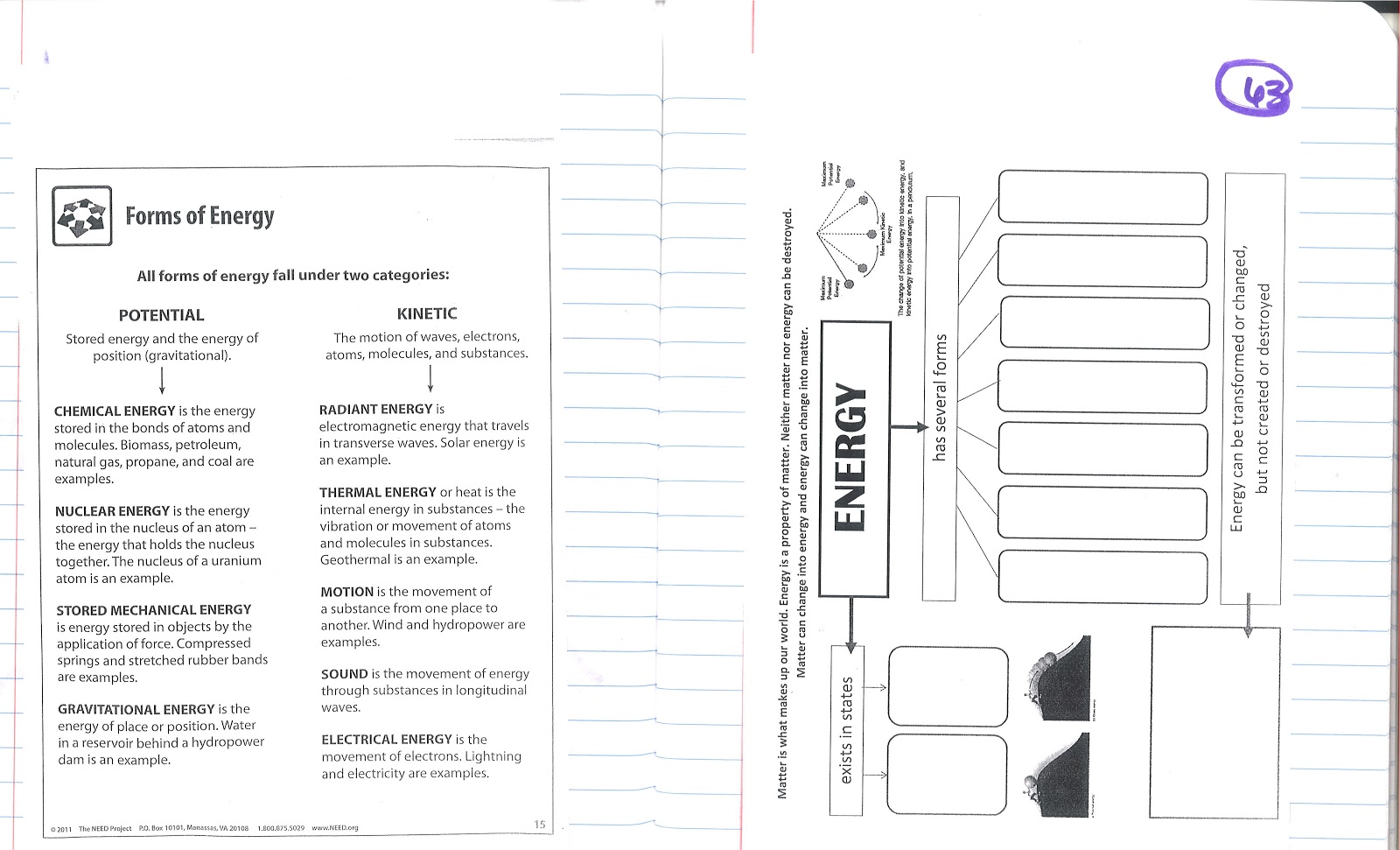
This week we are planning to incorporate all forms of energy into our study, not just Heat or Thermal Energy. Each form of energy will fit under either POTENTIAL or KINETIC energy forms.
We will use the phrase MRS CHEN to remember all the forms
M - mechanical (KE)
R - radiant (KE)
S - sound (KE)
C - chemical (PE)
H - heat (KE)
E - electrical (KE)
N - nuclear (PE)
This study is leading to the understanding that each form of energy transforms into other forms of energy very easily.
For example:
A blow dryer converts electrical energy into heat and sound energy.
A turbine converts heat into mechanical energy which in turn becomes electrical energy.
Our week was filled with mini labs using toys to demonstrate the energy changes when using toys and everyday objects.
February 10-22
In this time, we finished studying about kinetic and potential energy.
We had a lab using a curly cue to demonstrate convection and a lab melting chocolate chips to mainly demonstrate conduction, but we tied in all 3 ways to transfer heat.
We also began and ended a focus on the energy form thermal or heat energy (a subsection of kinetic energy). We discussed the 3 ways that heat can travel: conduction, convection and radiation.
We had a lab using a curly cue to demonstrate convection and a lab melting chocolate chips to mainly demonstrate conduction, but we tied in all 3 ways to transfer heat.
Friday, February 8, 2013
February 4 - 8
This week we started studying Physics. This will be a long unit covering the states and forms of energy and how energy relates to matter in motion (speed).
This week we started with the two major groups of energy--kinetic and potential energy---and the Law of Conservation of Energy.
We demonstrated the greatest amount of potential energy differs by object, but it is based on the position and mass of an object. Kinetic energy is the energy of matter in motion.
Vocabulary and cover page
to be completed as we go through different forms of energy
notes on KE and PE
Monday, January 7, 2013
January 5 - 22
This week we will begin the study of cells and cell theory.
There is no school on Friday.
Life Science topics covered
All living things are based on cells. There are two main types of cells - prokaryotic and eukaryotic.
Complex organisms such as humans (animals), plants, fungi and protists are based on eukaryotic cells with a nucleus and organelles.
Bacteria use prokaryotic cells (no nucleus).
3 Domains - Archaea, Bacteria, and Eukarya
The 3 Domains are divided into 6 kingdoms - Archaebacteria, Eubacteria, Plantae, Animalia, Fungi, and Protista
Students need to be aware the the key concepts for each taxonomic division (kingdom) include:
the number of cells: whether the organism is multicellular or unicellular
the type of cells: prokaryotic vs. eukaryotic
the type of reproduction: asexual (budding, fragmentation, fission) or sexual (fertilization)
and the method of food gathering: autotrophic or heterotropic
Thursday, December 13, 2012
December 3-14
Upcoming:
Vocabulary Quiz on Words 1-8 on the Life Science Vocabulary list. Quiz on December 19.Current work:
This week we began the study of ecosystems.Last week we reviewed chemistry and density and took a benchmark test.
Subscribe to:
Posts (Atom)